Penny Rim Errors: Every Type Explained (With Values and Identification Tips)
You’re going through a roll of Lincoln cents when something stops you. The edge looks wrong. One side is thicker than the other, there’s a raised blob of metal near the rim, or the coin is noticeably wider than every other penny in the roll. You’re looking at a potential rim error — and depending on exactly what you’ve found, it could be worth anywhere from a few dollars to several hundred.
Penny rim errors are among the most accessible and commonly found error coins in circulation. Because billions of Lincoln cents are produced every year, even rare error rates translate to thousands of coins that eventually reach pocket change, coin rolls, and estate collections. The catch is knowing what you’re actually looking at — and more importantly, knowing how to distinguish a genuine minting error from post-mint damage that’s worth nothing extra at all.
This guide covers all nine major types of penny rim errors, how to identify each one, what causes them in the minting process, and what they’re realistically worth on the current market.
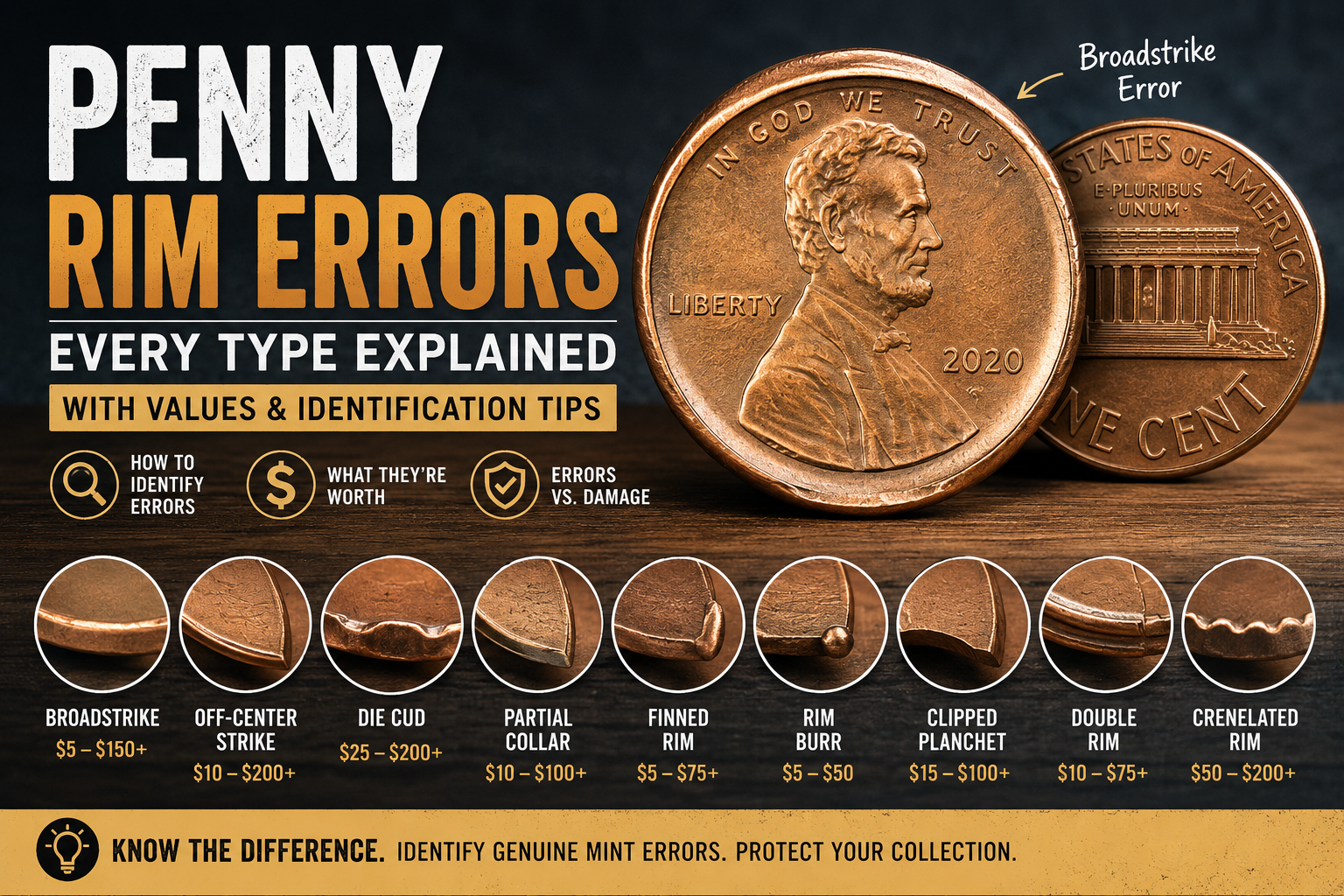
Quick Answer: Penny rim errors are minting mistakes that affect the outer edge of a Lincoln cent. The most common types include broadstrikes, off-center strikes, die cuds, partial collars, finned rims, rim burrs, clipped planchets, double rims, and crenelated rims. Values range from a few dollars for minor rim burrs to $200 or more for dramatic die cuds and crenelated rims. The first step with any suspected rim error is ruling out post-mint damage, which looks similar but adds no value.
How the Penny Rim Is Formed During Minting
To understand rim errors, it helps to know how a penny’s rim is supposed to be created. The process involves two separate stages, and errors can occur at either one.
Blank coin discs, called planchets, are first passed through an upsetting mill — a machine that squeezes the edge of each blank between two angled surfaces, raising it slightly into a rounded ridge. This upset rim is what eventually becomes the finished coin’s rim.
The planchet is then fed into the coining press, where it sits inside a retaining collar — a precisely sized ring that holds the coin in place during striking. The collar serves two functions: it constrains the metal so it can’t spread outward, and on dimes, quarters, and halves, it imparts the reeded edge. For cents, the collar produces a plain, smooth edge.
When either the upsetting mill or the retaining collar malfunctions, fails to engage, or is misaligned, the resulting coin carries a rim error that reflects exactly what went wrong at that stage of production.
Rim Error vs. Rim Damage: The Most Important Distinction in Coin Collecting
The majority of pennies with unusual-looking rims are not error coins. They are damaged coins — and damaged coins carry no premium over face value regardless of how dramatic they look. Knowing the difference protects you from overpaying for damage and from discarding a genuine find.
Signs of Post-Mint Damage (Not Errors)
Dents, dings, and flat spots: Random impacts from being dropped, banged against other coins, or stored carelessly. The affected area usually shows distortion of the nearby design detail.
Dryer coins: A coin that has been through a clothes dryer spins at high speed against the drum wall. The result is a rim that appears to fold or build up over the design edge — sometimes dramatically. These look unusual but have no added value.
Spooned coins: A deliberate modification where someone presses the coin’s edge against a hard surface to force the rim upward over the design. Closely resembles a dryer coin. Neither type is an error.
Filed or tooled edges: Any evidence of file marks, grinding, or deliberate edge alteration means the coin has been modified post-mint and is considered damaged.
Key Tests for a Genuine Rim Error
Consistency: A genuine minting error will be consistent with the physics of how it was produced. A broadstrike, for example, is uniformly wider all the way around, not dented on one side.
Design integrity: Most rim errors leave the design itself intact or shifted in a predictable pattern. Post-mint damage usually distorts or obscures specific areas of the design in ways that minting machinery would not.
Weight: A clipped planchet will weigh less than a standard Lincoln cent (3.11 grams). A broadstrike will weigh the same as a normal cent — the collar failed, but no metal was removed. A digital scale is your best friend here.
Edge surface: Genuine minting errors show clean, consistent anomalies. Damage typically shows irregular, sharp, or asymmetric distortion that doesn’t match any known minting failure pattern.
Rule of thumb: If the rim anomaly looks like something that could have happened in a pocket, a dryer, or a drawer, it almost certainly did. Genuine minting errors are the result of mechanical failure at the press — the irregularity will make sense when you understand what went wrong.
9 Types of Penny Rim Errors
1. Broadstrike Error
What causes it: The retaining collar fails to engage when the planchet is struck. Without the collar holding it in place, the metal spreads outward in all directions.
What it looks like: The coin is noticeably larger in diameter than a normal Lincoln cent and correspondingly thinner. The rim is flat, wide, and smooth rather than the usual defined ridge. The full design is present on both sides, just slightly flattened and spread. There is no reeding or edge lettering because the collar that would create those features was absent.
How to confirm it: Measure the diameter. A standard Lincoln cent measures 19.05mm. A broadstruck penny will typically measure 20mm or wider. The weight should still be approximately 3.11 grams (or 2.5 grams for post-1982 zinc cents) because no metal is missing.
Value on Lincoln cents: $9 to $25 for common dates in circulated grades. More dramatic broadstrikes with significant size increases, or those from scarcer years, can reach $100 to $250 or more.
2. Off-Center Strike
What causes it: The planchet is not properly centered under the dies when struck. The design is applied to only part of the coin, leaving the opposite portion as an unstruck blank crescent.
What it looks like: One portion of the coin shows a normal Lincoln design; the opposite portion is blank, smooth, and slightly curved. The coin may appear to have no rim on one side. Off-center errors are described by the percentage of the design that is missing — a 50% off-center penny has half the coin blank.
The date question: The date on Lincoln cents sits at the lower left of the obverse. Off-center errors that still show the complete date are significantly more valuable than those where the date has been struck off the edge. Always check for a full, visible date.
Value on Lincoln cents: $10 to $50 for 10% to 30% off-center examples. Coins that are 40% to 60% off-center with a full visible date can reach $50 to $100 or more. Dramatic examples with complete dates in high grades have sold for several hundred dollars.
3. Die Cud
What causes it: A large piece of the coin die breaks away from the rim area. Every time the damaged die strikes a new planchet, the void left by the missing die piece fills with metal, creating a raised, flat blob on the finished coin.
What it looks like: A die cud appears as a raised, featureless lump that extends inward from the coin’s rim onto the obverse or reverse field. Unlike a die crack (which is a raised line), a cud is a solid raised area with no design detail. It is connected to the rim, which distinguishes it from interior die breaks.
Size matters: Cuds are valued partly by their size. A small cud covering just a sliver of the rim commands modest premiums. A large cud consuming a quarter or more of one face is significantly more desirable and valuable.
Value on Lincoln cents: Smaller cuds typically bring $50 to $100. Dramatic cuds covering a large portion of the coin’s face can reach $150 to $200 or more. The specific date and mint mark affect value as well.
4. Partial Collar (Railroad Rim)
What causes it: The retaining collar only partially rises to meet the planchet during striking. Part of the coin is struck inside the collar (producing a normal rim on that side) and part is struck outside it (producing an expanded, reeded-looking edge on the other side).
What it looks like: One side of the coin’s edge has the normal smooth penny rim. The opposite side has a stepped appearance with what looks like reeding — vertical lines running around part of the edge, similar to the edge of a dime or quarter. This is why collectors call it the ‘railroad rim’ effect. The transition between the normal and the stepped edge is usually abrupt and easy to see.
Value on Lincoln cents: $25 to $150 depending on how clearly defined the collar step is and how much of the coin’s circumference is affected. More dramatic examples with a clear, complete railroad effect on one hemisphere command higher prices.
5. Finned Rim
What causes it: Excessive striking pressure forces metal into the narrow gap between the die neck and the collar, squeezing it upward into a thin, blade-like protrusion along the rim edge.
What it looks like: A thin, sharp fin of metal extending upward from the rim’s outer edge, running parallel to the face of the coin. The fin may run all the way around the coin or appear only in sections. It can appear on one face, both faces, or along the edge itself. Run your fingernail along the rim — a finned rim will catch slightly, while a normal rim is smooth.
Value on Lincoln cents: $10 to $75 depending on how pronounced and complete the fin is. Full-circumference finned rim cents in uncirculated condition are the most desirable examples.
6. Rim Burr
What causes it: Damage to the coin die causes metal to scrape against the collar during striking and fold or deposit onto the coin’s rim as a small protrusion or rough patch.
What it looks like: Small, irregular raised spots or rough patches along the rim’s edge. Unlike a finned rim (which runs in a consistent line), rim burrs are localized and irregular. They can feel jagged or sharp under a fingernail. Close inspection with a loupe is needed to distinguish burrs from minor damage.
Value on Lincoln cents: $5 to $30. Rim burrs are the least dramatic and least valuable of the common rim errors. Significant, clearly defined burrs on otherwise high-grade coins command the higher end of this range.
7. Clipped Planchet
What causes it: During the blank preparation stage, a punch that cuts individual planchets from a long metal strip occasionally overlaps with a hole already punched from that strip. The result is a planchet with a curved chunk missing from its edge before any design is ever struck on it.
What it looks like: A curved (crescent-shaped) or occasionally straight notch cut into the coin’s edge. The design is still present everywhere else on the coin, but the affected area has no rim and no design detail. The missing section will always be smooth rather than jagged — it was punched cleanly, not broken off.
Straight vs. curved clips: Curved clips (the most common) result from the overlapping punch pattern described above. Straight clips result from the metal strip not feeding correctly through the punching machine, leaving a flat cut across the planchet’s edge.
The Blakesley Effect: On a genuine clipped planchet, the coin will show a weakly struck or flat area directly opposite the clip. This is called the Blakesley Effect, and it’s one of the most reliable authenticity tests for this error type. If the area opposite the clip looks perfectly normal, the coin may be a damaged coin rather than a true clipped planchet.
Value on Lincoln cents: Small clips (5% to 10% missing) bring $10 to $40. Medium clips (10% to 20%) reach $40 to $150. Large clips (20% or more) in uncirculated condition can bring $200 to $400 or more at auction.
8. Double Rim / Misaligned Die
What causes it: When the obverse and reverse dies are slightly misaligned relative to each other during striking, the result is a coin where the rim is thicker or more pronounced on one side and thinner or missing on the other. Weak strikes can also produce a secondary rim effect.
What it looks like: Two concentric raised lines running parallel along the rim, or an uneven rim that is noticeably thicker on one part of the coin’s circumference and thinner on the opposite side. On some examples, the date or lettering near one rim may appear crowded or shifted toward the edge.
Value on Lincoln cents: $5 to $50. Most double rim pennies are minor in their effect and command modest premiums. Dramatic misalignment creating an obviously uneven or double rim is worth more.
9. Crenelated Rim
What causes it: After the coin is struck inside the collar, something causes it to be pushed sideways out of the collar rather than ejected cleanly upward. This lateral movement causes the coin’s edge to be dragged across the collar’s reeded inner surface, leaving vertical reeding impressions along the junction between the coin’s rim and edge.
What it looks like: A series of short vertical lines or ridges running along the edge of the coin, resembling a miniature picket fence or castle battlement (hence ‘crenelated’). On a Lincoln cent, which normally has a plain smooth edge, this reeding is immediately obvious and distinctive. The reeding always points toward the reverse — the face struck by the anvil die.
Value on Lincoln cents: $50 to $200 or more. Crenelated rims are considered rare and are among the more sought-after rim errors on Lincoln cents. Clear, well-defined examples in higher grades command the top end of this range.
Quick-Reference Value Table: Penny Rim Errors
Use this table as a field guide when examining a Lincoln cent with a potential rim error.
| Rim Error Type | What Causes It | How to Spot It on a Penny | Typical Value Range |
| Broadstrike | Retaining collar fails to engage | Coin is wider and flatter than normal; smooth, flat rim; full design visible | $9 – $250+ |
| Off-Center Strike | Planchet misaligned when struck | Design shifted to one side; crescent of blank metal on opposite side; partial or missing date | $10 – $100+ (date visible = higher) |
| Die Cud | Piece of die breaks off at rim | Raised, flat blob of metal extending from rim onto coin face | $50 – $200+ |
| Partial Collar (Railroad Rim) | Collar only partially engages during strike | One side normal rim, other side reeded like a dime; ‘stepped’ edge | $25 – $150+ |
| Finned Rim | Excess striking pressure forces metal upward | Thin, blade-like metal protrusion running along rim edge | $10 – $75 |
| Rim Burr | Damaged die leaves metal scraping on edge | Jagged or rough spots along rim; irregular raised metal | $5 – $30 |
| Clipped Planchet | Punch overlaps previous hole in metal strip | Curved or straight chunk of edge missing; coin is underweight | $10 – $400+ (size-dependent) |
| Double Rim / Misaligned Die | Dies are slightly misaligned during striking | Two concentric rim lines visible; uneven rim thickness around coin | $5 – $50+ |
| Crenelated Rim | Coin pushed out of collar after striking | Vertical reeding extensions resembling a picket fence along the edge | $50 – $200+ |
Note: All values are approximate market ranges for circulated to lightly circulated examples of common Lincoln cent dates. Scarce key dates (1909-S VDB, 1914-D, 1931-S, 1955 DDO, etc.) with rim errors command significant additional premiums. High-grade uncirculated examples can also far exceed these ranges.
Notable Penny Rim Errors Worth Knowing
BIE Errors: The Rim-Adjacent Die Crack Unique to Lincoln Cents
One error type specific to Lincoln cents deserves a mention here, even though it’s technically a die crack rather than a pure rim error. BIE errors occur when a vertical die crack develops between the letters B and E in the word LIBERTY on the obverse, creating what looks like a capital letter I between those two letters. Because LIBERTY runs along the inner rim of the coin, BIE errors are visually connected to the rim area and are frequently discussed alongside rim errors in Lincoln cent collecting circles.
BIE pennies are common enough that they’re classified more as varieties than true rarities, but they’re still collectible. Values run from $3 to $5 for typical examples, with more dramatic cracks commanding slightly more.
Dramatic Broadstrikes from the Early Wheat Cent Era
Broadstruck Lincoln Wheat cents from the 1910s and 1920s are among the most visually striking examples of this error type. Press equipment during this period was less reliable than modern machinery, and collar failures occurred with some regularity. A 1921 broadstruck wheat cent in circulated condition can bring $100 to $250, with uncirculated examples reaching $400 to $800 depending on the degree of spread and overall eye appeal.
Large Die Cuds on Modern Lincoln Shield Cents
Die cud errors are still found on modern Lincoln cents, including the Lincoln Shield reverse design introduced in 2010. A 2025-S Lincoln Shield cent with a significant reverse rim cud was documented in the error coin community, illustrating that these errors continue to occur despite modern quality controls. Large cuds on any Lincoln cent date are worth professional evaluation.
How to Get a Penny Rim Error Graded and Sold
For rim errors valued under approximately $50, professional grading typically doesn’t make financial sense. The submission fee alone can approach or exceed the coin’s error premium. For these lower-value rim errors, selling raw (ungraded) through eBay or to local dealers is usually more practical.
For higher-value finds — dramatic die cuds, large clipped planchets, or well-defined partial collars — professional grading through PCGS or NGC adds authentication and significantly increases buyer confidence, which typically translates to a higher realized sale price.
PCGS (Professional Coin Grading Service): Submit through their website or an authorized dealer. Economy tier submissions work for most rim error pennies.
NGC (Numismatic Guaranty Company): Similar process. NGC has strong support for error coins and designates verified error types on the label.
CONECA: The Combined Organizations of Numismatic Error Collectors of America is the leading authority specifically on error coins. Their attribution service can confirm an error type before you decide whether to pay for PCGS or NGC grading.
Selling options: Graded error pennies sell best through Heritage Auctions, Stack’s Bowers, or GreatCollections for higher-value pieces. eBay works well for mid-range rim errors. Local coin dealers are the fastest option but typically offer wholesale rather than retail prices.
Tools You Need to Identify Penny Rim Errors at Home
10x loupe or magnifier: The minimum magnification for reliably identifying rim burrs, crenelations, and fine fin details. A 10x optically correct jeweler’s loupe is inexpensive and sufficient for most rim error identification.
Digital scale (0.01g precision): Essential for confirming clipped planchets (underweight) and ruling out broadstrikes versus damaged coins. Standard Lincoln cents post-1982 weigh 2.50 grams; pre-1982 copper cents weigh 3.11 grams.
Digital calipers: For measuring diameter on suspected broadstrikes. A standard Lincoln cent measures exactly 19.05mm. Anything measurably wider warrants further investigation.
Bright directional light: Angle a flashlight or desk lamp across the coin’s surface at a low angle. This raking light technique reveals surface details — including rim protrusions and burrs — that are invisible under flat overhead lighting.
Reference resources: The CONECA master die list, PCGS CoinFacts (free online), and the Cherrypickers’ Guide to Rare Die Varieties are the standard references for confirming Lincoln cent errors and varieties.
Frequently Asked Questions
How do I know if my penny rim error is real or just damage?
The most reliable approach is to ask whether the anomaly could be explained by minting machinery failure. Genuine rim errors are consistent with a specific mechanical failure — a broadstrike is evenly wider all around, a partial collar has a predictable stepped pattern, a clipped planchet has a clean curved cut and shows the Blakesley Effect opposite the clip. Post-mint damage tends to be localized, irregular, and inconsistent with any known press malfunction. When in doubt, weigh the coin, measure the diameter, and post clear photos to an error coin forum like CONECA’s community or the r/coinerrors subreddit.
What is the most valuable rim error on a Lincoln cent?
Among rim-specific errors, large die cuds and crenelated rims on scarcer date Lincoln cents are typically the most valuable, reaching $200 or more for dramatic examples. Large clipped planchets in uncirculated condition from early wheat cent dates can reach $400 or more. That said, the most valuable Lincoln cent errors overall are not rim errors — the 1943 copper cent and the 1955 doubled die obverse are in a separate category entirely.
Is a broadstruck penny worth anything?
Yes, but modestly for most examples. Common-date broadstruck Lincoln cents in circulated condition typically sell for $9 to $25. More dramatic broadstrikes — those that are significantly wider than normal — or examples on scarcer dates can bring more. The key factors are how obviously wide the coin is, whether the design is fully intact, and the coin’s overall condition.
What is the Blakesley Effect and why does it matter?
The Blakesley Effect is a diagnostic tool specific to clipped planchet errors. When a planchet is missing a section due to an overlapping punch, the area directly opposite the clip will show a weakly struck or flat area on the finished coin. This happens because the missing metal reduces the pressure the collar can apply in that zone during striking. If a coin has what looks like a clip but shows perfectly normal striking strength on the opposite side, it is likely a damaged coin rather than a genuine clipped planchet.
Should I clean a penny rim error before selling it?
Never. Cleaning a coin — any coin, error or not — damages the surface and dramatically reduces its value to collectors. Even gentle wiping with a cloth can leave hairline scratches visible under magnification that professional graders will note as cleaning. Store the coin in a non-PVC flip or airtight coin holder and sell it in the condition you found it.
Where is the best place to sell penny rim errors?
For common rim errors worth under $30, eBay raw (ungraded) is the most practical option — search completed sales for your specific error type to set a realistic asking price. For errors worth $50 to $150, a local coin show or reputable online dealer can work well. For dramatic or high-value rim errors, consider having the coin professionally graded first, then selling through a major auction house like Heritage Auctions where error coin collectors actively bid.
Final Thoughts
Penny rim errors are one of the best entry points into error coin collecting precisely because the host coin is so common. You don’t need to spend anything to search through rolls of Lincoln cents, and the potential upside — finding a dramatic die cud, a well-defined partial collar, or a large clipped planchet — makes the search genuinely worthwhile.
The skills that matter most are not rare: learn to distinguish genuine minting errors from post-mint damage, keep a digital scale and loupe handy, and know which rim anomalies are worth getting excited about. Most odd-looking pennies in circulation are just old and worn. But occasionally, one isn’t.

Abhishek Nale is a digital publisher, SEO strategist, and content creator behind the-daily.buzz. He writes and curates content across technology, business, finance, lifestyle, health, travel, and trending topics, with a focus on creating clear, practical, and engaging content for modern readers.